
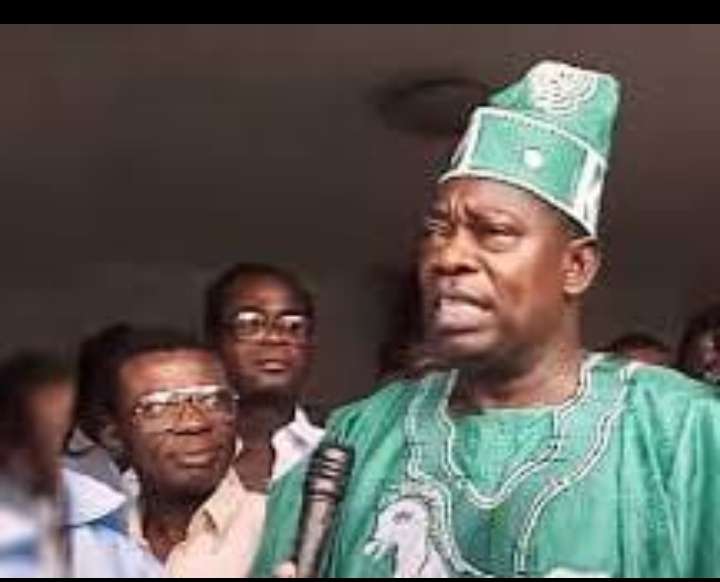
By Richard Odusanya

On this day, July 7, 2026, Nigerians at home and across the diaspora commemorate the 28th anniversary of the passing of Bashorun Moshood Kashimawo Olawale (M.K.O.) Abiola—business mogul, entrepreneur, philanthropist, sports promoter, statesman, and the widely acknowledged winner of the historic June 12, 1993 presidential election.

M.K.O. Abiola died on July 7, 1998, while in detention, just as arrangements were reportedly being made for his release. His death marked one of the most painful chapters in Nigeria’s democratic journey. Today, his name remains inseparable from June 12, a date that has rightly become Nigeria’s Democracy Day in recognition of the extraordinary mandate freely given to him by Nigerians.
JUNE 12: A NATIONAL MANDATE BEYOND TRIBE AND RELIGION
The June 12, 1993 election occupies a unique place in Nigeria’s political history. It demonstrated that Nigerians could rise above ethnic, religious, and regional divisions to vote for competence, hope, and national unity.
Running on his memorable “Farewell to Poverty” campaign, Abiola attracted support from every part of the country. His victory was widely regarded as a genuine national mandate, arguably the broadest electoral consensus ever achieved in Nigeria’s democratic experience.
The election also challenged the long-held belief that national elections in Nigeria could only be won through manipulation, intimidation, or sectional alliances. June 12 proved otherwise.
The Price of Principle
When the election was annulled, Abiola faced a defining choice: accept political compromise in exchange for personal freedom or stand by the mandate freely given to him by millions of Nigerians. He chose principle.
Despite years of detention under military rule, he reportedly refused opportunities that would have required him to renounce his mandate. Whether one agrees with every political decision he made, history remembers him as a man who placed conviction above personal comfort.
His often-quoted declaration, “The only entity I fear is Almighty God,” reflected the courage with which he confronted overwhelming state power.
He ultimately paid the supreme price, dying in detention at the age of 60. The circumstances surrounding his death continue to provoke debate and historical inquiry.
THE LONG SHADOW OF THE ANNULMENTS
The annulment of June 12 represented far more than the cancellation of an election. It interrupted the democratic aspirations of an entire nation.
The crisis reshaped Nigeria’s political trajectory. Military leaders tightened their grip on power, while some politicians who had initially identified with the pro-democracy struggle later aligned with successive administrations. Others remained steadfast in the struggle through organizations such as those whose sustained advocacy helped keep the demand for democracy alive.
Ultimately, the sacrifices of Abiola and countless pro-democracy activists contributed significantly to Nigeria’s return to civilian rule in 1999.
*Lessons for Today’s Nigeria*
Twenty-eight years after his passing, M.K.O. Abiola’s life continues to offer profound lessons.
First, democracy is not sustained merely by conducting elections; it survives only when the will of the people is respected.
Second, national unity is achievable when leadership appeals to shared aspirations rather than ethnic or religious divisions.
Third, public office should be viewed as a platform for service rather than personal enrichment.
Finally, history reminds us that while power may be temporary, integrity, sacrifice, and courage endure far beyond one’s lifetime.
AN UNFINISHED NATIONAL ASSIGNMENT
Although June 12 is now officially recognized as Democracy Day, the ideals that inspired that struggle remain works in progress. Electoral integrity, accountable governance, rule of law, and social justice continue to challenge Nigeria’s democratic development.
The most meaningful tribute to Bashorun M.K.O. Abiola is, therefore, not merely to remember his sacrifice once a year but to build the Nigeria for which he was prepared to sacrifice everything.
As we remember him today, may his life inspire present and future generations to defend truth over expediency, justice over oppression, and national interest over personal ambition.
May his memory continue to remind us that democracy is sustained not by monuments or public holidays but by citizens and leaders who possess the courage to protect the people’s mandate.
May the soul of Bashorun M.K.O. Abiola continues to rest in peace, and may Nigeria never again witness the subversion of the freely expressed will of her people.
One final perspective is this: M.K.O. Abiola’s greatest legacy was not simply that Abiola won an election but that he fundamentally changed Nigerians’ understanding of what was politically possible. June 12 demonstrated that, despite deep ethnic and religious diversity, Nigerians could unite behind a common vision when presented with credible leadership. That lesson remains as relevant today as it was in 1993.
@richardODUSANYA