

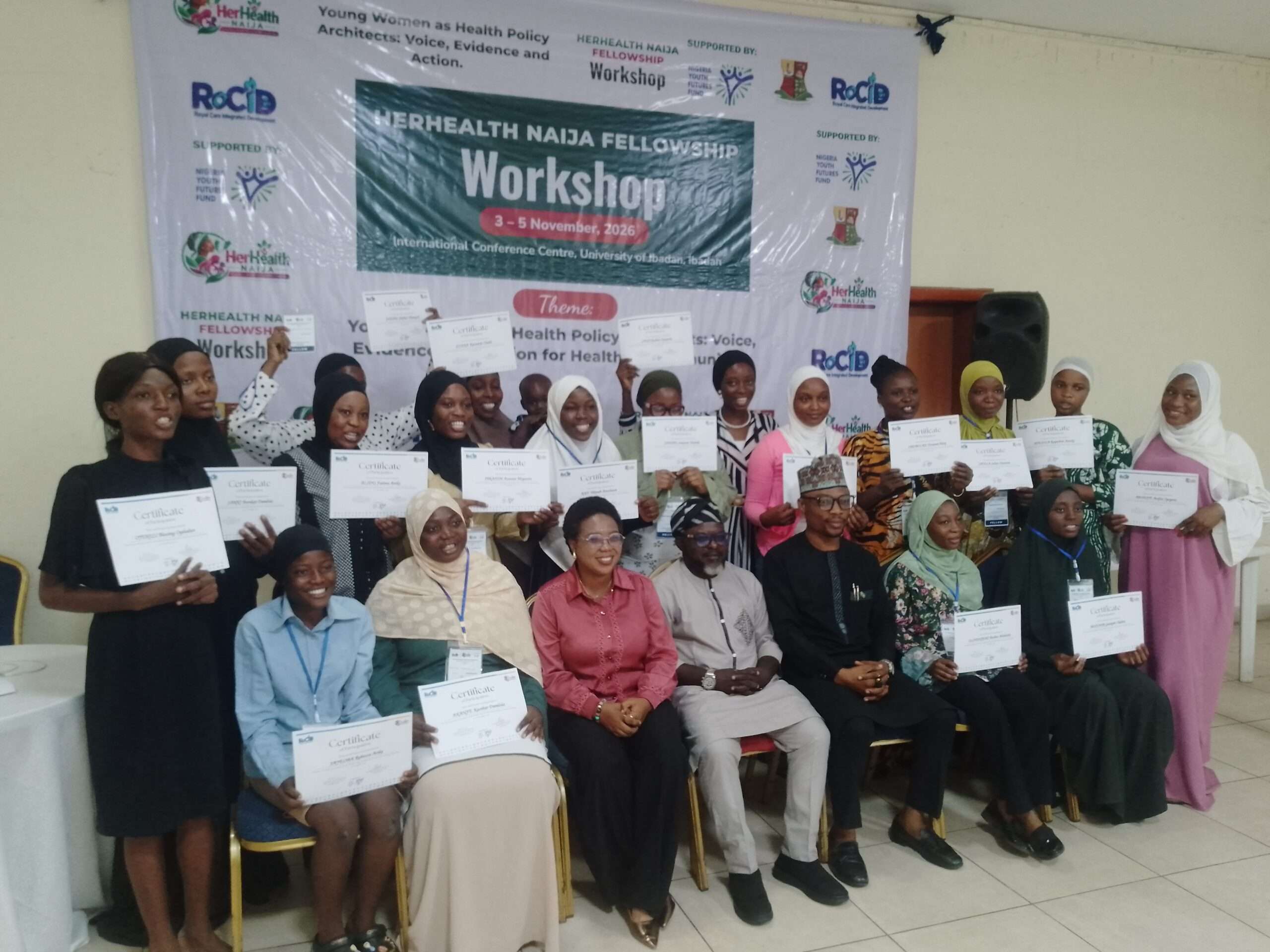
Twenty-five young women selected from various local government areas of Oyo State and inducted into the first cohort of the HerHealth Naija Health Policy Architects Fellowship Programme have been presented certificate to commence their activities.
The certificate gives them the mandate to conduct community-based research and advocate improved reproductive, maternal, newborn, child and adolescent health services.

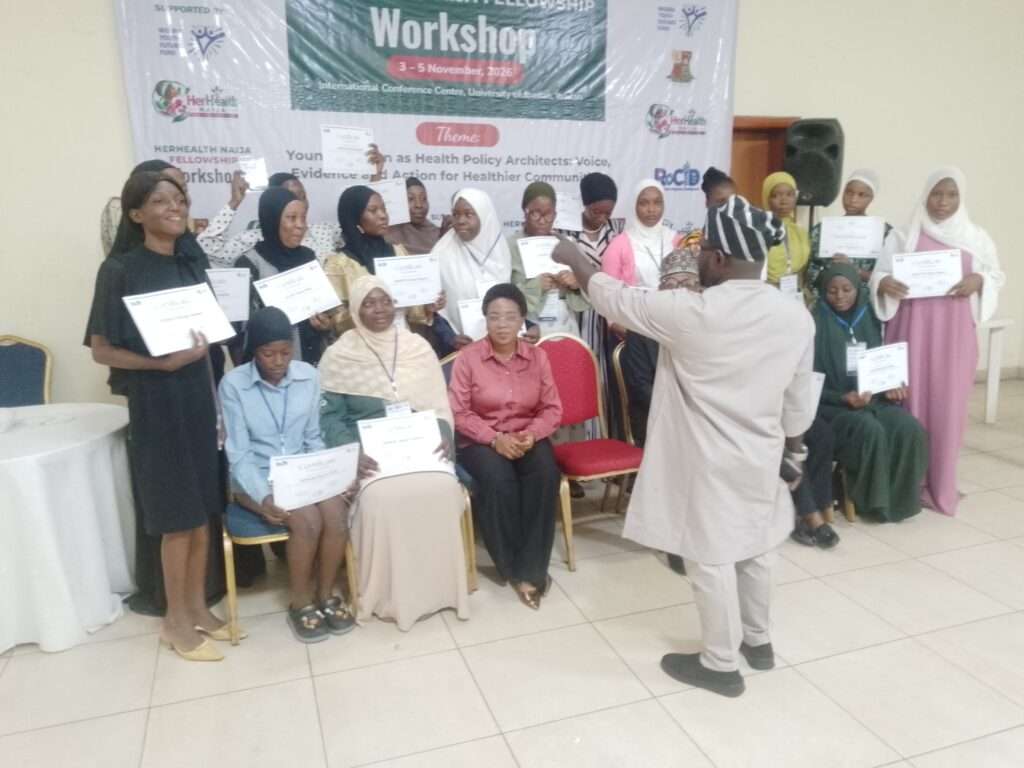
The fellows were presented with certificates following a three-day capacity-building workshop held from November 3 to 5, 2026, at the International Conference Centre, University of Ibadan.
The programme, an initiative of the RoCID, is designed to strengthen Reproductive, Maternal, Newborn, Child and Adolescent Health (RMNCAH) services through community-driven research, evidence-based policy development and effective advocacy.

The participants were drawn from Egbeda, Ido, Ibadan North, Iseyin, Ona Ara, Akinyele, Ibadan South-West, Ibadan North-West, Atiba, Ogbomoso, Ibadan South-East, Kajola and Ibarapa East local government areas.
Speaking on the objectives of the fellowship, the Executive Director of RoCID, Dr Kehinde Adegoke, said the programme was established to equip young women with the skills required to influence health policies and improve service delivery.
Dr. Adegoke explained that many challenges affecting maternal, newborn, child and adolescent healthcare were not necessarily related to lack of awareness but to weaknesses in the planning, funding and delivery of health services.

He identified some of the challenges as informal charges in health facilities, inadequate staffing during night shifts, shortages of drugs and medical supplies, judgmental treatment of adolescents and inaccessible healthcare facilities for persons with disabilities.
According to him, young women experience many of these challenges in their communities but are often excluded from the decision-making processes that determine how healthcare services are provided.
He said the three-day workshop was therefore designed to equip the fellows with practical knowledge in health policy analysis, community research, policy writing, legislative engagement, advocacy and media communication.
Dr. Adegoke added that the selection of participants from different local government areas was deliberate to ensure that the evidence gathered would reflect the experiences and healthcare needs of communities across the state.
On their responsibilities after the workshop, he said the fellows would return to their respective communities to gather evidence through ethically approved surveys, focus group discussions, interviews and observations at health facilities.
Their findings, he explained, would be developed into concise, evidence-based policy memos containing practical recommendations for improving healthcare delivery.
The recommendations would subsequently be presented to policymakers at a state-level policy dialogue involving the Ministry of Health, relevant government agencies and the Oyo State House of Assembly.
He further disclosed that the programme would feature an eight-episode podcast series and an online digital campaign under the hashtags #TheNigeriaWeWant and #HerHealthNaija, through which the fellows would share their communities’ experiences and amplify issues affecting women’s and children’s health.
On sustainability, Adegoke said the programme was designed to create lasting community impact through the development of an alumni network, government engagement, reusable training resources and additional partnerships.
He noted that RoCID would seek further collaboration and funding beyond its current Nigeria Youth Futures Fund grant, while expressing hope for stronger partnerships with local government authorities and the state government.
He disclosed that the fellowship would run from September 2026 to February 2027, with community fieldwork and policy memo development taking place in the coming weeks, followed by the podcast series and policy dialogue before its conclusion in February 2027.
Speaking with Oodua News, the Executive Director of Get Healthy Africa Initiatives and Chairman of the programme, Honourable Faysol Oluwakemi, emphasised the importance of the lectures delivered during the workshop, saying they would strengthen the fellows’ capacity to engage government officials and lawmakers on healthcare policy issues.
He explained that his sessions focused on how participants could organise strategic meetings with legislators and government officials, present advocacy demands effectively and understand the mechanisms required to promote accountability.
According to him, the lectures were designed to give the fellows practical guidance on engaging decision-makers and presenting evidence-based arguments capable of advancing their objectives.
“My first lecture centred on conducting strategic meetings with legislators in a way that would make their presentations appeal to lawmakers based on the subject matter. My second lecture focused on advocacy strategy and accountability mechanisms,” he said.
Also speaking, the Programmes Manager at Fluximation Production, Evelyn Ohiolei, said her lecture focused on media engagement, podcast planning and digital storytelling as strategic tools for effective health advocacy.
She explained that media could transform research evidence into public conversations, build trust, influence decision-makers and drive social change when used responsibly.
Ohiolei said the participants were exposed to different communication channels, including radio, television, print media, podcasts, social media and community networks, as well as practical tools such as media pitches, press releases, interview briefs, talking points and spokesperson preparation.
She also highlighted the importance of purposeful podcast production, stressing the need to define episode objectives, identify target audiences, select relevant guests, prepare compelling questions and ensure that every episode has a clear call to action.
On digital storytelling, she introduced participants to a six-frame approach involving the person, problem, evidence, systemic cause, solution and call to action.
She said the approach would help the fellows connect individual experiences with broader healthcare challenges and possible solutions.
Ohiolei further emphasised ethical media representation, particularly the need to protect the dignity, privacy, consent and safety of vulnerable persons, including young women, adolescents and survivors of gender-based violence.
She urged the fellows to verify information before sharing it, correct misinformation responsibly and work with credible voices to ensure that advocacy messages remained accurate and trustworthy.
Some of the participants who spoke with Oodua News expressed satisfaction with the training, describing the three-day programme as educative and enlightening.
Blessing Oyelade from Akinyele Local Government Area, Okunlola Wuraola from Ibadan South-West and Azeezat Ibrahim from Ona Ara Local Government Area said the workshop had broadened their understanding of women’s healthcare needs and equipped them with useful knowledge for community engagement.
They said the training had exposed them to important aspects of women’s health and how community-driven research, evidence-based policies and effective advocacy could contribute to improved healthcare services.
The fellows expressed optimism that the knowledge acquired would help them identify challenges affecting women and other vulnerable groups in their communities and make informed recommendations to relevant authorities.
The HerHealth Naija Fellowship is expected to conclude in February 2027, following the completion of community research, policy engagements and media advocacy activities.