

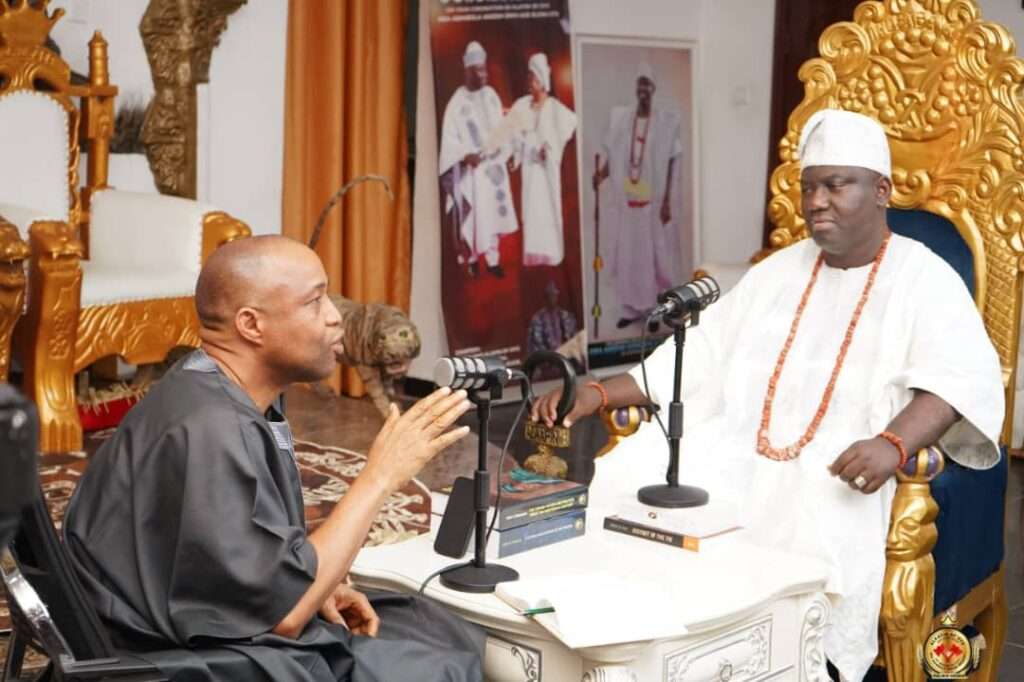

The Alaafin of Oyo, His Imperial Majesty, Oba Engr. Abimbola Akeem Owoade I, has called on all sons and daughters of Yorubaland to approach Yoruba history with wisdom, responsibility and mutual respect.
The monarch said harmonization of norms and values embedded in traditional institutions with the modern system of governance remains the antidote to eradicating problems of access to justice and conflict resolution in the country.

Oba Owoade made the call during an interview programme, State Affairs, held at the ancient palace in Oyo.
In a release by his Director of Media and Publicity, Bode Durojaiye, the Alaafin welcomed the growing interest in Yoruba history and civilisation, describing it as an opportunity to reconnect present and future generations with the achievements and legacies of their ancestors.
He however cautioned against using historical discussions to ridicule fellow Yoruba people, disparage traditional rulers or create divisions among communities.

According to him, Yoruba history reflects the contributions of numerous kingdoms, towns, royal houses, families and individuals, adding that no community needs to diminish another to establish its historical importance.
“Historical accounts should remain open to investigation, correction and reassessment, guided by credible evidence, intellectual honesty and civility,” Oba Owoade said.
He expressed concern that some online discussions have degenerated into contests of superiority, personal attacks and attempts to discredit particular communities and traditional institutions.
The Paramount Ruler cautioned against using the history of one community as a weapon against another, describing Yorubaland’s diversity as a source of historical richness rather than division.
He encouraged historians and researchers to examine events within their proper contexts, distinguish established facts from uncertainties, and objectively assess new discoveries.
“Pride in one’s ancestry should never become arrogance or contempt for the ancestry of others,” he stressed.
Oba Owoade urged commentators not to allow the pursuit of online popularity to override historical accuracy and the collective dignity of the Yoruba people, saying critically examining history is different from deliberately humiliating the people and institutions associated with it.
“Let me also particularly appeal to youths and content creators to use social media to educate, enlighten and unite, rather than spread misinformation or provoke hostility. I urge you to consult credible historians for facts, investigate community histories and distinguish documented facts from oral traditions, scholarly interpretations and unverified claims. Bi a ba ta ara ile eni lopo, a ki i tun ri ra lowon,” he said.
He therefore called on traditional rulers, historians, cultural organisations and educational institutions to collaborate in documenting oral traditions, preserving historical sites and making credible historical knowledge accessible to younger generations.
“My dear sons and daughters of Yorubaland, our history is a precious inheritance entrusted to us by our ancestors. We must study it, question it, correct its inaccuracies and preserve it for generations yet unborn.
“We may come from different towns and kingdoms and hold different opinions about our past. That diversity should enrich our understanding, not become a reason for hostility. No Yoruba community needs to pull another down to establish its importance, and no individual needs to insult a royal father to demonstrate historical knowledge.
“Let us seek the truth without malice, debate without bitterness and correct one another without humiliation. Let us use our knowledge to unite rather than divide, enlighten rather than mislead, and preserve rather than destroy.
“May we be remembered as the generation that deepened the understanding of Yoruba history while protecting the dignity of our people and the honour of the heritage entrusted to us,” Oba Owoade said.
On the Oyo Empire Day celebration, the monarch said the objective was not only to organize a successful celebration each year, but to establish it as a sustainable, enduring and internationally recognized annual cultural event.
“It is an initiative born from my vision to reconnect people with their ancestry, stimulate scholarship, preserve heritage, promote tourism, and create a platform through which Oyo’s past can contribute to its future,” he said.
He hinted that the proposed Museum of Yoruba Culture and Civilization and Oyo Empire Day Hall of Fame are part of the broader vision of creating permanent institutions through which heritage can be preserved.
On the inclusion of traditional rulers in the nation’s constitution, the Alaafin argued that harmonization of norms and values embedded in traditional institutions with modern governance is imperative because socio-cultural norms have remained an integral part of the people.
“Apart from being a powerful human tool for survival, the defined cultural norms and values also form the bases of existence of every civilized society and they bring order which in turn makes the society devoid of any state of lawlessness,” he said.
“The art of resolving conflict is borne out of a belief that conflict which is inevitable should not and must not be left alone, but be put under control by interacting with relevant parties to develop common principles and practices that would return cordial relationship against violence.
“During conflicts, traditional rulers therefore undoubtedly played significant roles in managing these conflicts informally and arranging peace-making meetings when matters get out of hand. These governance institutions and structures were controlled by certain unwritten laws which formed part of general social structure, and its machinery of enforcing governance was well organized to manage affairs, administered justice and resolve tension in the society.
“However, during colonial era, there was a role change as the roles and offices of traditional rulers were either usurped by the colonialists or their subjects,” Oba Owoade asserted.