
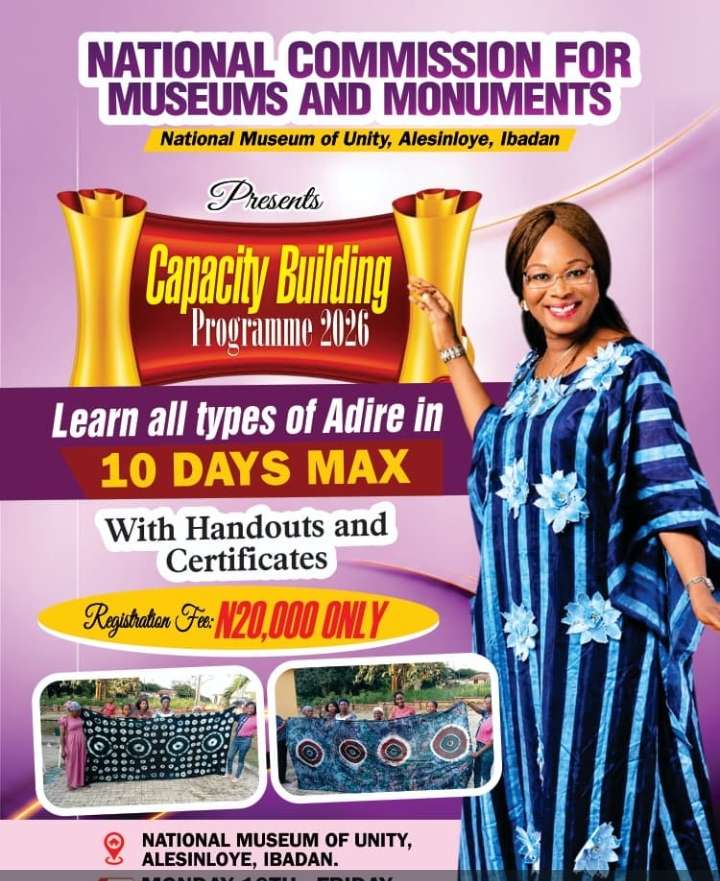
The National Museum of Unity, Aleshinloye, Ibadan, has concluded plans for another edition of its annual Adire capacity-building programme aimed at equipping Nigerians with practical skills in indigenous textile production and entrepreneurship.

The Deputy Director of Education at the National Museum of Unity, Ibadan, Dr. Olatunde Caroline Oluyemi, disclosed this in an interview with Oodua News, saying the programme is organised by the National Museum of Unity under the auspices of the National Commission for Museums and Monuments (NCMM).

According to her, the initiative was established to preserve Nigeria’s rich cultural heritage while empowering participants with vocational skills that can enable them to become self-employed and create employment opportunities for others.
Dr. Oluyemi explained that the Adire training programme, which began in 2011, has become an annual event and has consistently provided participants with practical knowledge in traditional textile production.
According to her, this year’s training program will commence from Monday 10 to Friday 21 August, 2026.
She noted that over the years, the programme has trained more than 1,000 participants from Ibadan and neighbouring communities, many of whom have successfully established businesses in Adire production and marketing.
“Since the commencement of the programme in 2011, we have empowered over one thousand people. Many of them are doing very well in the business today and have become financially independent,” she said.
She added that the programme has attracted participants from different parts of Oyo State, including Oyo, Iseyin, Lalupon, Iwo and several other communities, demonstrating the growing popularity and relevance of Adire production as a viable means of livelihood.
Dr. Oluyemi explained that the training is open to young school leavers, retirees, unemployed youths, artisans and individuals seeking additional sources of income.
According to her, the initiative is designed to address unemployment by providing participants with practical skills capable of generating sustainable income.
“With the knowledge of Adire production, participants can become self-employed and also establish businesses that will create employment opportunities for other people. It is a lucrative enterprise that is gaining acceptance across Nigeria and beyond,” she stated.
She further revealed that participants in this year’s edition will receive comprehensive training in the production of 25 different Adire designs, while also learning effective marketing strategies to help them commercialize their products.
“We will teach participants how to produce about 25 different types of Adire and equally expose them to strategies for marketing their products. During this year’s programme, participants will learn 25 unique Adire designs, and we will continue to mentor and monitor them until they attain professional standards,” she said.
Dr. Oluyemi described Adire making as an important aspect of Nigeria’s cultural heritage that has evolved into a profitable business with increasing local and international demand.
She stressed that beyond preserving indigenous culture, the programme contributes significantly to youth empowerment, entrepreneurship development and economic growth.
She assured intending participants that the training would combine theoretical and practical sessions, with comprehensive instructional materials provided throughout the programme.
At the end of the exercise, participants who successfully complete the training will receive certificates of participation as evidence of the skills acquired.
The Deputy Director disclosed that the intensive training will last for 10 days, while participants will receive structured learning materials and continuous mentorship throughout the programme. Registration for the training has been fixed at ₦20,000.
She therefore encouraged interested members of the public, particularly youths, women, retirees and aspiring entrepreneurs, to take advantage of the opportunity to acquire a skill capable of guaranteeing financial independence.
Dr. Oluyemi reiterated the commitment of the National Museum of Unity and the National Commission for Museums and Monuments to promoting Nigeria’s cultural heritage while empowering citizens through vocational education and skills acquisition programmes that contribute to national development.