
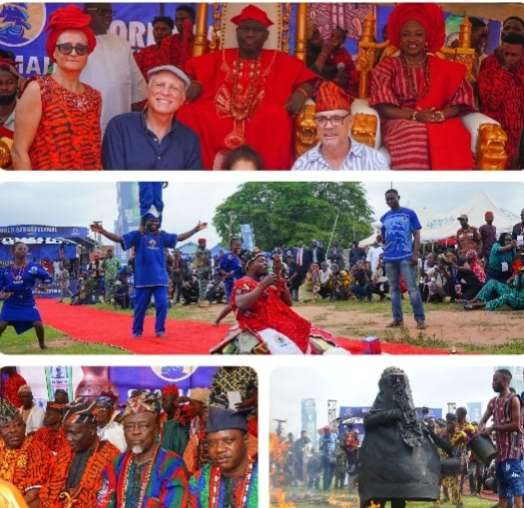


The Alaafin of Oyo, Oba Abimbola Owoade 1, has called for Yoruba cultural studies should go beyond a study of the performing traditions, but should begin to emphasize scholarship in the intellectual foundation of this universal culture.
He also urged relevant stakeholders to support genuine efforts to promote the study of Sango, the celebration of the festival in his honour and the appropriation of the virtues of leadership demonstrated by Sango.
In a release by his Director of Media and Publicity, Bode Durojaiye, Oba Owoade gave the admonition in Saturday at the grand finale of this year’s World Sango Festival held at the ancient Palace in Oyo City.
According to the Paramount Ruler, “” in this era of African cultural awakening, the life, leadership, administration and government under Sango as Alaafin here in Oyo
should be explored in the strictest academic tradition and the ennobling values intellectualized. The life of Alaafin Sango would definitely be an excellent example in leadership, considering the fact that his rule of Oyo was for less than a decade””.
He submitted that the festival gave another opportunity to examine
and conceptualize the entire building qualities of Sango and use that
as a possibly template for efforts in nation-building.
Said he, “” the Yoruba Diaspora was an ever-expanding world, next only to the J in
terms of relevance and number. Sango indeed was at the heart of this expanding world of the Yoruba and competing favourably with other.religions to explain spiritual and physical mysteries.
“” Hence, substantial support must be provided for efforts to expand the celebration of Sango Festival as part of a grand agenda in cultural tourism and the study of Sango’s leadership and heroic attributes as basis for national orientation.
“” We are at a momentous and critical stage in the historical development of our country, when we are looking back, trying to re-define the system of government in order to establish a responsible and responsive government. I have no doubt
that a thorough study of the knowledge system and society that will produced the archetypal African system here in Oyo will [provide that direction we missed in the past””.
A celebration of Sango as evidenced in the festival , Oba Owoade
asserted provided everyone with a rare opportunity to define his or her attitude to culture by identifying with the virtues of Sango, and in so doing equip ourselves with an understanding of these virtues that transformed Sango from being just the fourth ruler of the kingdom of Oyo to global brand that he has become today.
The Royal Fatger enjoined Yoruba in diaspora to immerse themselves
in their religious and traditions for spiritual strengthening, personal fulfilment in life, global understanding and harmony.
In his words, “” you should look beyond the challenges of nation-building we are currently facing in Nigeria and concentrate attention on the spiritual significance of your home coming to rebuild your cultural identity and spiritual self-rediscovery””.
Explaining the essence of the festival, Alaafin pointed out that going
by the happenings around the world in contemporary times, there is the need for Yoruba as a people to retain our traditional and cultural identity in the face of the global village, which the world has become as a result of fast-improving technology.
“”Sango was preferred because he was a man of valour, purpose-driven
and master of diplomacy. He became king when Oyo at its formative stage and surrounded by mighty and warlike states such as Nupe, Ibariba and Owu.
“” His charismatic leadership re-defined the character and pattern of
inter-group relations and diplomacy and made Oyo the centre-piece of
his foreign relations. His short reign consolidated the position of Oyo as the foremost Guinea Savannah State and also secured the independence and
sovereignty of the nascent kingdom. Sango paid the supreme sacrifice and left Oyo more grandiose, more stable, better administered and more secured than he met the nascent kingdom. He was today been remembered as ‘’one of the rare African leaders who became instant success in empire building.
“” While great countries celebrate their glorious past, Africans do not give much reverence to theirs due to super-imposition of the two main religions of Islam and Christianity. Unfortunately, preachers of these two religions are known for etching
their sermons and creed into the consciousness of Africans’ psyche, which have conditioned our sense of appreciation and thinking. The colonial mentality has blindfolded us and made us to perceive erroneously our invaluable culture and tradition as fetish.
“” This has also resulted in the way we picture our past heroes and great men of
valour and virtues, who should be immortalised, venerated and celebrated. Not only that, their deeds, acts and wise sayings were worthy of compiled, documented, reserved and preserved for generation yet unborn “”.
Oba Owoade urged the Yorubas to give necessary supports to their
tradition and culture so that the race could be stand out in the world.
He advised the parents to always teach their wards Yoruba language saying that “research had shown that children that learn yoruba easily understands other languages”.