
By Richard Odusanya

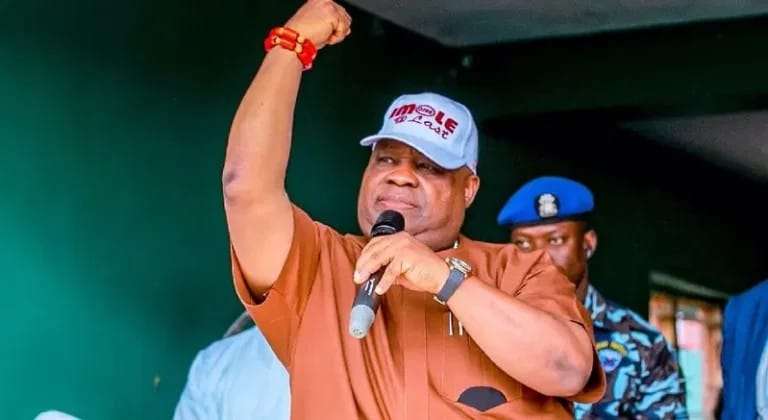
Osun decides 2026….Victory was announced. The celebrations began. There was dancing, jubilation and renewed hope. I stood in white, brown cap on my head, beside Senator Ademola Adeleke.

Yesterday, he won again. Congratulations, sir.
But beyond the celebration and the symbolism of another electoral victory lies a more troubling reality—one that goes beyond Osun State and speaks directly to the condition of Nigeria’s democracy.
For between the joy of victory and the mechanics of winning elections, the same old vices appeared again: hunger in the land, frozen government accounts, imposed candidates, threats, ballot stuffing and vote buying.
These are not merely isolated electoral irregularities. They are symptoms of a political system struggling to serve the very people whose votes confer legitimacy on those in power.
When Elections Become a Test of Survival
Senator Babafemi Ojudu’s reflections on why the All Progressives Congress (APC) lost the Osun election provide a sobering insight into the crisis confronting Nigeria’s political system.
Among his 15 reasons are issues that point to a deeper institutional failure—what may simply be described as a broken system.
The invasion of politics by governors, political insults that eventually backfire, and the tendency of political actors to boast about power rather than demonstrate service all reveal a dangerous disconnect between leadership and the people.
Politics, in such an environment, ceases to be about ideas, policies and public service. It becomes a contest for control, influence and survival.
Yet, amid the darkness, one point in Ojudu’s assessment offers a powerful reason for hope.
He identified the people of Osun as determined and fearless citizens who confronted thugs allegedly deployed to seize ballot boxes.That is the Nigeria we should be building.
A Nigeria where citizens refuse to surrender their democratic rights to intimidation.A Nigeria where the ballot box belongs to the voter and not to the strongest political actor.
A Nigeria where citizens understand that democracy is not a gift from politicians but a right that must be protected.
The Problem Is Bigger Than the Politicians. For years, Nigerians have heard different diagnoses of the country’s political and democratic problems.
Afrobeat musician Femi Kuti has repeatedly challenged the strength and effectiveness of Nigeria’s institutions.
Omoyele Sowore, the activist and politician, has similarly used the metaphor of a faulty vehicle to describe a country where changing political leaders does not necessarily repair the underlying system.
Now, from within the political establishment, Ojudu’s assessment provides another dimension to the argument. The message is difficult to ignore: changing political parties or personalities alone may not be enough if the institutions themselves remain weak.
Osun 2022 and Osun 2026 therefore offer lessons that extend beyond the boundaries of the state.
They remind us that elections are not merely about who wins and who loses. They are also about the condition of the society in which those elections take place.
A Generation Is Watching;
Perhaps the most important stakeholders in this conversation are young Nigerians.
They are watching:
They are watching how candidates emerge. They are watching how votes are acquired. They are watching how political violence is treated. They are watching whether competence matters more than connections and whether public service is rewarded or punished.
The increasing attraction of young Nigerians to the idea of Japa—leaving the country in search of opportunities elsewhere—is not simply an economic phenomenon.
It is also a question of hope.
When young people conclude that their future cannot be secured through education, enterprise, participation and democratic engagement, they naturally begin to look elsewhere.
When elections are associated with violence, intimidation and vote buying, trust in democracy begins to disappear.
And when citizens lose faith in the ballot, the consequences are much bigger than any single election.
Culture, Strategy and Courage:
Yet, there is another side to the Nigerian story.The people have not completely given up.
Culture continues to mobilise them. Music continues to speak to them. Social media continues to connect them. Young people continue to debate, organise and demand accountability.
From dance steps to Davido, from political debates to media engagement, Nigerians continue to find creative ways of expressing identity, frustration and hope.
This is where culture and civic participation intersect. The same energy that fills a concert can fill a civic movement. The same creativity that produces music can produce new political ideas.
The same courage displayed at the ballot box can become the foundation for institutional reform.
The challenge is to transform spontaneous energy into organised civic power.
Why Witness 2026 Matters;
It is against this backdrop that WITNESS 2026 becomes important. Witness 2026 is not conceived as another platform for attacking individuals or settling political scores.
It is an attempt to look beyond personalities and diagnose the system itself. The central question is simple:
What kind of political and institutional model can give Nigerians a democracy in which votes count, citizens are safe and public institutions work for everyone?
The answers must go beyond party politics. Nigeria needs institutions that are genuinely independent.
It needs consequences for wrongdoing regardless of political affiliation. It needs electoral processes in which the will of the people is protected. It needs citizens who are informed, organised and courageous enough to defend their votes.
And above all, it needs a political culture that places human lives and public welfare above the pursuit of power.
From Ede to the Nation;
What happens in Ede does not have to remain an Ede story. What happens in Osun does not have to remain an Osun story.
Every election is an opportunity to examine the health of the Nigerian project.
The victory photographs may capture the excitement of the moment. The dancing may capture the joy of the people. The political speeches may capture the triumph of candidates.
But behind every celebration are citizens whose lives continue after the election.
They need food.
They need security.
They need jobs.
They need functioning institutions.
They need justice.
They need leaders who understand that political power is a responsibility, not a trophy.
Witness 2026 therefore comes at a critical moment. It is a call to observe, document, question and rethink. It is a call to move from merely witnessing elections to witnessing the consequences of the systems that produce them.
Nigeria cannot continue to celebrate victories today and mourn democratic failures tomorrow. We cannot keep changing drivers while refusing to repair the car. We cannot continue dancing in one photograph and mourning in the next.
The real victory will come when Nigerian citizens no longer have to choose between hope and survival.
That is why Witness 2026 matters.
From Ede to the nation, the question is no longer simply who won. The greater question is: what kind of Nigeria are we building?
By Richard Odusanya
Architect of Dialogue