
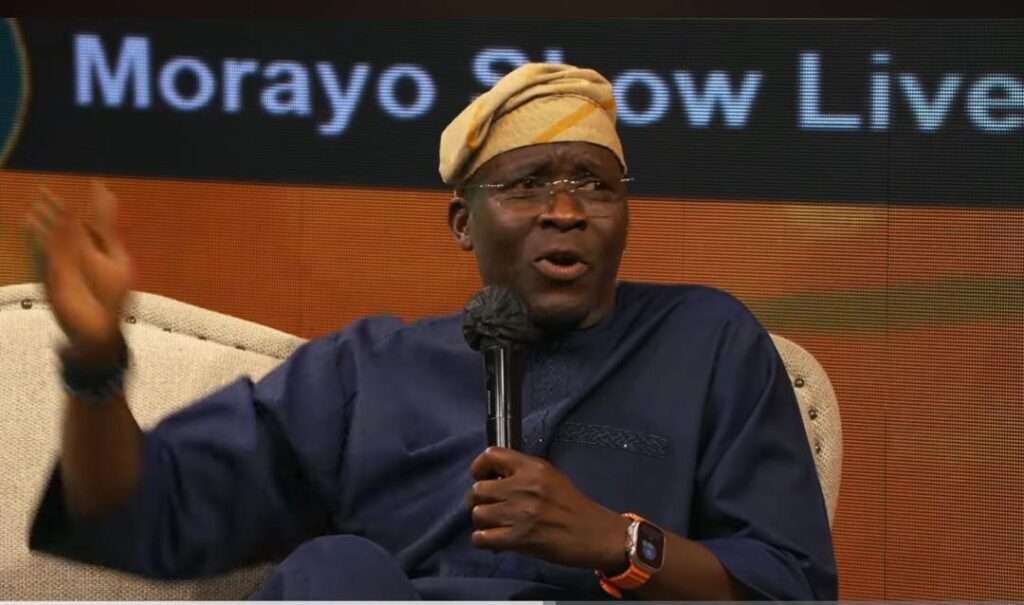


The Social Democratic Party, SDP, governorship candidate in Oyo State, Mogaji Olusegun Agboola, has said his ambition to govern the state is driven by a desire to deploy his private sector accomplishments and expertise to public service.
Agboola stated this while speaking on the Morayo Show in Ibadan, where he explained that his decision to contest the 2027 governorship election was influenced by what he described as a divine call and the need for accomplished individuals to join politics.
“Every youth should aspire for anything available. That’s the first call. And the second call is that, I mean, I’m sure this is probably close to home. I was very young when this activity was going on. By the time we kicked out the military, we were done,” he said.
According to him, his decision was also informed by his conviction that societal problems cannot be solved by individuals who remain outside government.
“Today is not better than that time. So we thought, is there something else we can do? We need to bring our accomplishments to the public sector. We’re already doing it as private individuals through charity organisations. But the greatest good we can do is with those publics,” he said.
Agboola added that he and others had spent years demanding good governance without results, prompting his entry into the race.
“We have been at their necks for many years now, and we see they’re not budging, they’re not listening to us. So we thought if we join the race, surely they’ll be forced to listen,” he said.
The SDP candidate, who described himself as an Ibadan-born and bred indigene, said he attended primary school in Felele, Ibadan, before proceeding to the University of Ibadan for his first degree and later studies abroad.
Speaking on his approach to governance, Agboola said he intends to replace what he termed “pedestrian thinking” with a system-based approach to solving problems, noting that many government interventions only address symptoms.
“Most of what they do now is just put plaster on the problem and tell you we’ve done enough. Most of the time, the solution is systemic,” he said.
Citing education as an example, he said improving school infrastructure alone would not fix the sector without attention to teachers and learning materials, lamenting that Oyo is now the worst educationally developed state in the South-West.
“Oyo State is the worst educationally developed state in the entire South-West. It never used to be so. Oyo State was one of the top three states that must have the highest marks to get any national knowledge,” he said.
He also faulted poorly executed road projects and criticized the use of state resources on federal infrastructure, particularly the Ibadan airport.
“I’m still very upset about it. How can a sitting government take money that belongs to the development of the state, go to a federal infrastructure and start ploughing money you can never recoup there?” he queried.
On his seven-point agenda, Agboola said he would prioritize strong local government administration, arguing that development is best achieved when communities are empowered to identify their needs.
“How can it be a distraction? There’s no state without the local government. Your state is made up of 33 local governments,” he said.
“The local government chairman there should be able to tell you, these are the problems of our people. These are the solutions we want to implement.”
On the recent change in SDP’s governorship ticket where Michael Okunlade was substituted with him at a substitution plenary in Ibadan, Agboola said internal disagreements are not peculiar to his party.
“There’s no party without their internal struggle. In the case of SDP, SDP is the cleanest of all the parties. I’m telling you. Google it,” he said.
He said the SDP remains committed to providing an alternative platform and preventing a drift to a one-party system.
“We can’t really have a one-party system. Let us be able to hear ourselves. Let’s have healthy debates and things that we want solutions of,” he said.
Agboola urged voters to value their votes and look beyond inducements at the polls.
“They tell you your vote doesn’t count. Yet, they’re coming to give you money to come and pass it for them. Just think again, that if it wasn’t valuable, would they be asking you for it?” he said.
“When you get to the polls, ask yourself, if I’m the director that needs to choose a leader, will I be happy to follow this one? Does this one know the road?” He concluded