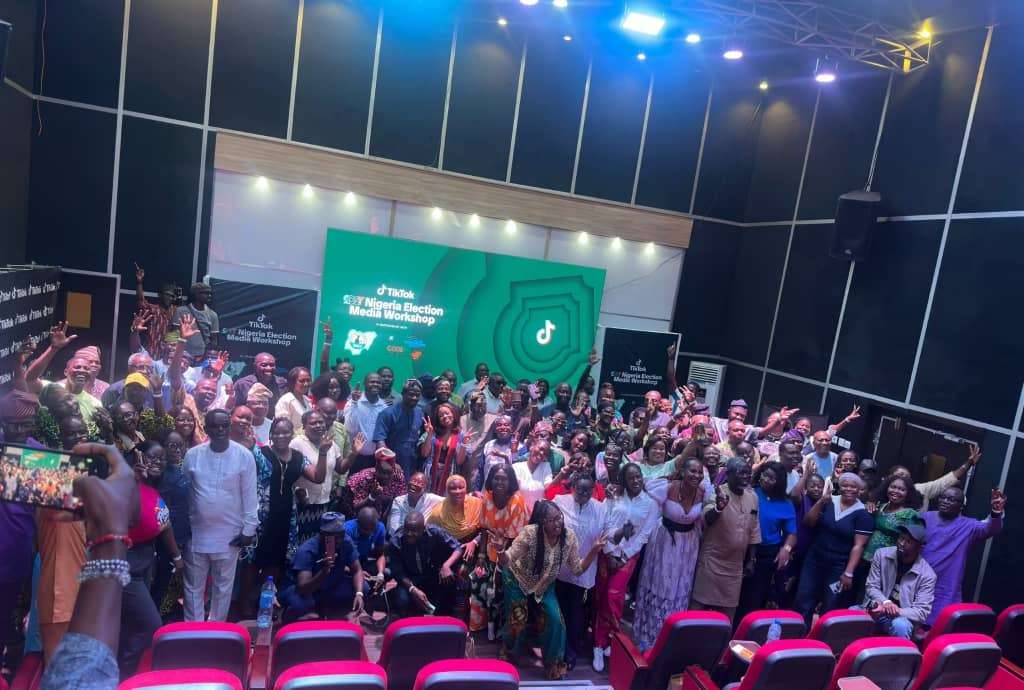

TikTok, in partnership with the Nigeria Union of Journalists (NUJ), Oyo State Council, has trained 150 journalists in Oyo State to combat election misinformation ahead of Nigeria’s 2027 general elections.
                                            The capacity-building workshop focused on election integrity, responsible digital engagement, and effective use of TikTok for news dissemination was held on friday at the Donion FM hall, Iyaganku, Ibadan
                                                                     It forms part of efforts to strengthen journalists’ capacity to promote credible information, responsible digital engagement and electoral accountability ahead of Nigeria’s 2027 general elections.
                                       TikTok representative, Giyahile Makhoba, from Johannesburg, South Africa, said the company was committed to supporting journalists in telling their stories and helping them understand how to engage effectively with the platform.
Makhoba, who disclosed that she had worked with TikTok for about five years, said the platform had evolved beyond its initial perception as a space mainly for entertainment and young people, noting that it had increasingly become a community for people of different ages and interests.

She observed that more journalists were embracing TikTok for news dissemination, making capacity-building partnerships with media organisations particularly important.
According to her, the training was designed to strengthen journalists’ understanding of the platform and equip them to make effective use of its opportunities.
Speaking on election integrity, Makhoba emphasised the need for collaboration among media organisations, technology platforms, civil society organisations, regulators and the Independent National Electoral Commission (INEC) to empower citizens to critically assess information consumed and shared on digital platforms.

She explained that TikTok’s election integrity responsibility went beyond providing access to the platform, adding that it also involved protecting users, empowering communities and working with relevant organisations to ensure accurate and timely information reached the public during elections.
On content moderation, Makhoba said TikTok operated established Community Guidelines and policies governing users’ activities and the type of content allowed on the platform.
She clarified that not all content that failed to appear on users’ For You feeds had necessarily been removed for violating platform rules, explaining that some content might simply not meet the requirements for recommendation.
She added that content moderation was guided by established community standards rather than arbitrary decisions to punish users.
Makhoba also introduced Melody and OEME as members of the TikTok support team who would remain available to assist participants with questions and challenges arising after the workshop.
She further announced that Code for Africa, TikTok’s long-standing fact-checking partner, would contribute to the training, describing its work as valuable to the fight against misinformation.
In his remarks, the Chairman of the Nigeria Union of Journalists (NUJ), Oyo State Council, Comrade Akeem Abas, commended TikTok for the partnership, describing it as an investment in journalism, democracy and the integrity of the electoral process.
He charged the 150 participants to maximise the opportunity, acquire new skills and transfer the knowledge gained to their respective newsrooms, adding that the Oyo NUJ remained committed to embracing innovation without abandoning the ethics and principles of journalism.
Abas urged journalists to embrace emerging technologies while maintaining professional standards, warning that digital visibility, virality and large followership should never be mistaken for credibility.
He also called on journalists to verify information, authenticate digital materials and interrogate political claims before publication, noting that false reports could inflame tensions and undermine public confidence.