


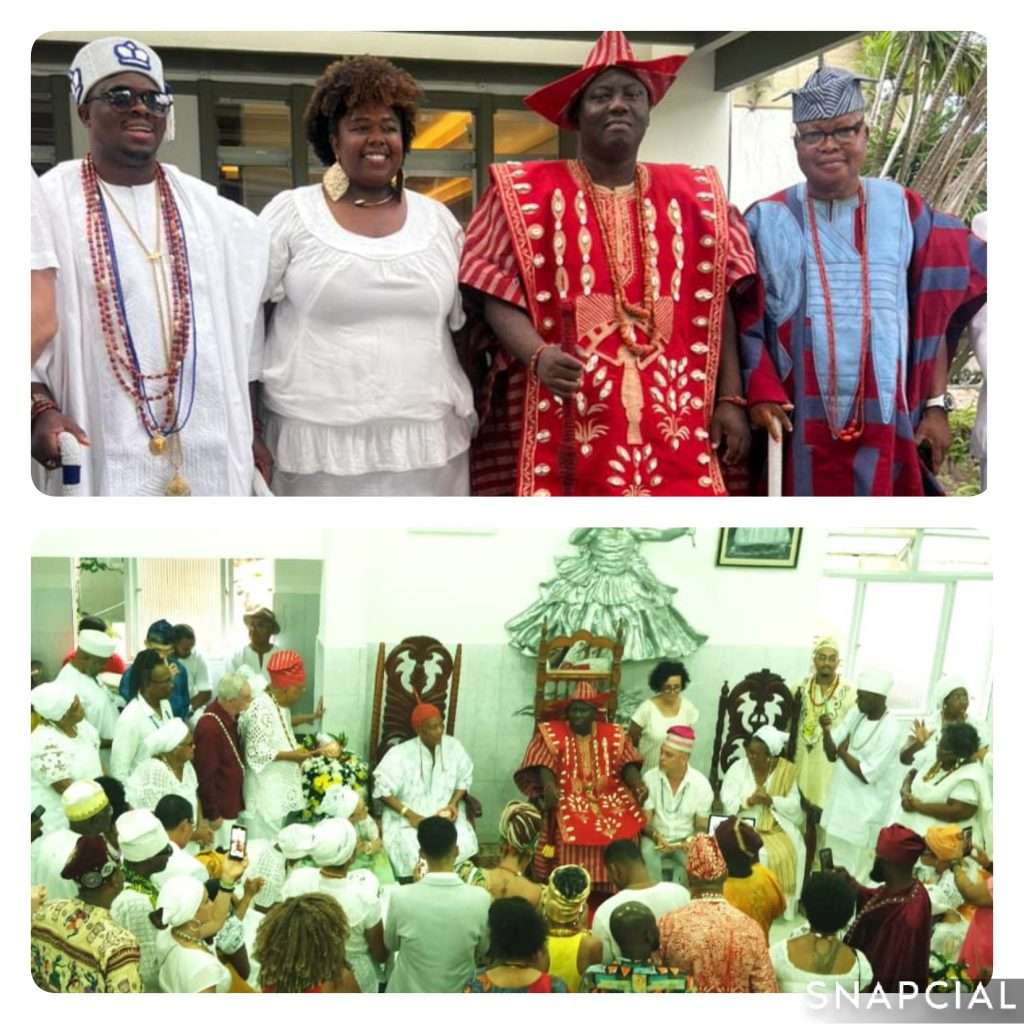
In this report, BODE DUROJAIYE, the Director of of Media and Publicity to the Alaafin and the Titan of Yorubaland, writes on the significance of the visit of Oba Engineer Abimbola Akeem Owoade1, which he described as a powerful affirmation of shared history, ancestry, identity, and the enduring legacy of the Kingdom of Ọ̀yọ́ among Afro-Brazilian communities that have faithfully preserved Yorùbá civilization across generations.
Alaafin’s visit underscored the growing cultural relationship between Nigeria and Brazil, where millions continue to preserve Yorùbá traditions through Candomblé, language, music, festivals, and ancestral practices.
The occasion was during his historic visit to the Bámgboṣé Family in Salvador, Bahia, Brazil, where Elders of “Pilão de Prata, affirmed that their ancestry is Ọ̀yọ́.
It was a remarkable chapter in the historic Brazilian tour of His Imperial Majesty,
as the occasion became a profound celebration of ancestry and cultural continuity when respected elders of Terreiro Pilão de Prata—one of Bahia’s most revered Candomblé temples—affirmed the family’s ancestral ties to the historic Kingdom of Ọ̀yọ́.Royalty
The visit united traditional rulers, Ifa Priests, Ìyálórìṣà, Babalórìṣà, scholars, community leaders, and hundreds of Afro-Brazilians in what many described as a symbolic homecoming between the Kingdom of Ọ̀yọ́ and descendants of Yorùbá ancestors whose traditions have endured in Brazil for generations.Ancestry & Genealogy.
The occasion highlighted the extraordinary resilience of Afro-Brazilian culture. More than a century after separation from their ancestral homeland, families such as the Bamgboses continue to preserve names, customs, rituals, and historical memories that maintain a living connection with the Kingdom of Ọ̀yọ́.
Throughout the gathering, the Alaafin warmly greeted elders and members of the Bamgbose family while receiving traditional salutations from religious leaders and representatives of the Afro-Brazilian community.
Clad in magnificent crimson royal regalia associated with the legacy of Ṣàngó, the legendary Aláàfìn of Old Ọ̀yọ́, the Paramount Ruler made a commanding entrance that immediately captivated the gathering. The brilliant red attire symbolized royal authority, courage, justice, and the enduring heritage of one of Africa’s greatest empires.Latinos & Latin-Americans
As the sound of traditional drums filled the air, Oba Owoade was welcomed with resounding chants of “Kábíyèsí!”, “Ṣàngó Olúkòso!”, and other royal praises. The atmosphere was deeply emotional, with many attendees describing the occasion as witnessing the living continuity of the Aláàfìn’s sacred institution, which remains inseparable from the historical legacy of Ṣàngó in Yorùbá civilization.
One of the most significant moments of the ceremony came when elders of Terreiro Pilão de Prata publicly spoke about the Bamgbose family’s ancestral origins.
Drawing upon oral traditions carefully preserved within the community, they affirmed that the family traces its lineage to the ancient Kingdom of Ọ̀yọ́.
According to these traditions, their Yorùbá ancestors carried their language, spirituality, customs, and family identity across the Atlantic during the era of enslavement, preserving them despite generations of displacement.People & Society
The public recognition of the Bamgbose lineage before the Aláàfìn transformed the royal visit into a moving reunion between descendants of Africa and one of the continent’s oldest surviving royal institutions. For many present, it symbolized the restoration of an ancestral connection that has survived centuries through memory, faith, and tradition.Africans and Diaspora.
The reception also reinforced the expanding cultural dialogue between traditional institutions in Nigeria and the African diaspora in Brazil. Elders expressed hope that the Aláàfìn’s historic tour would encourage deeper academic collaboration, cultural exchange, heritage preservation, and stronger bonds between both sides of the Atlantic.Demographics
In his address at the colourful occasion, Oba Owoade expressed dismay at the extent to which the Yoruba have sold out their own culture and have adopted foreign gods as the object of their spiritual religion.
Said he, “”as a people, our culture, politics and religious experience have been extremely unfulfilled. The Yorubas are now falling in the same condition through which the African Americans had allowed themselves to be seduced by preachers of a foreign gospel. We know that the universalist inspiration which has come to the Yoruba through Christianity and Islam has reduced their concern or allegiance to their own god and by extension to their own nationality.
“”The Yoruba will be very much reduced in their political, cultural and spiritual development by their seduction into these alien religions. Concerted efforts must be intensified at increasing inspiration to become national or to recognise nationhood.
“” So with that, we see the Yoruba in the diaspora, as it is popularly called, to be the Yoruba that will greatly guide and influence the Yoruba in the ancient homeland, who for the most part are tending to move away from a sense of preservation of their own culture and tradition, particularly religion””.
He observed that it is time Yoruba at home and in Diaspora start partnering
for synergy.
According to him, “” without doubt, we can’t find strength in unity . This has become imperative so that whenever our brothers and sisters in Diaspora come home, they won’t be complainers about how things are not working, but rather, they would see themselves as partners and partakers in the overall development for a better future of their home land.
“” Partnership is a voluntary collaborative agreement between two or more parties in which all participants agree to work together to achieve a common purpose””.
Partnerships, he explained, share interest, concerns and create visions for
the future.
“” In this technology-driven age, when the whole world has virtually dissolved into a global village, meaningfully partnering is a foundation for success. This is because such collaboration enables continuous improvement which is created when it doesn’t seem possible to solve a problem or address the situation by just one group – due to magnitude, lack of knowledge or vague nature of the issue at stake; or when the cost of solving a problem or addressing an issue gets too costly for one group to tackle””.
In an enterprise therefore, the Alaafin pointed out that the best partnerships are those (either formal or informal) that have an organization or a structure with shared vision, mission and goals, involving people for maximum utilization of emerging and existing technologies.
“” In this regard, the kind of partnering one envisages between the Yoruba at home and in Diaspora is the type that will provide necessary developmental planks such as intellectual, technological, communication and marketing plans for the homeland that is urgent for modern transformation. This is with a view that such an alliance will produce results that will benefit all group and process members””.
The Titan of Yorubaland later enthralled attendees with a majestic royal dance inspired by the warrior traditions of Ṣàngó Olúkòso.
Accompanied by powerful drumming and traditional chants, the performance reflected the dignity, strength, and courage historically associated with the Aláàfìn’s throne. Spectators responded with prolonged applause, celebrating what many regarded as a living expression of Yorùbá royal heritage, people and society
The reception also reinforced the expanding cultural dialogue between traditional institutions in Nigeria and the African diaspora in Brazil. Elders expressed hope that the Aláàfìn’s historic tour would encourage deeper academic collaboration, cultural exchange, heritage preservation, and stronger bonds between both sides of the Atlantic.Demographics
As the celebrations concluded, participants described the visit as one of the defining moments of the Aláàfìn’s tour, as His visit to the Bamgbose family represented far more than a royal courtesy.
For those gathered in Salvador, the day will be remembered as a historic reunion of family, culture, and royal heritage, reaffirming that the spirit and legacy of the Kingdom of Ọ̀yọ́ continue to flourish across the Atlantic.Latinos and Latin-Americans.
Other historic places visited by the Alaafin included, the the Oldest Òrìṣà House in Salvador, Brazil, where the Brazilians celebrated Olúkòso, and the Brazilians of ÌJÈṢÀ Descent in Salvador, Bahia , at the130-Year-Old Ilé-Àṣẹ Kálẹ̀ Òbòkún-Ìjèṣà, among others.