

‘

…Says Oyo culture remains Africa’s blueprint for development
The Alaafin of Oyo, His Imperial Majesty, Oba Engineer Abimbola Akeem Owoade I, has declared that the Yoruba indigenous knowledge system is built on an uncommon commitment to inquiry, research, investigation, and functional application to solve human existential problems.
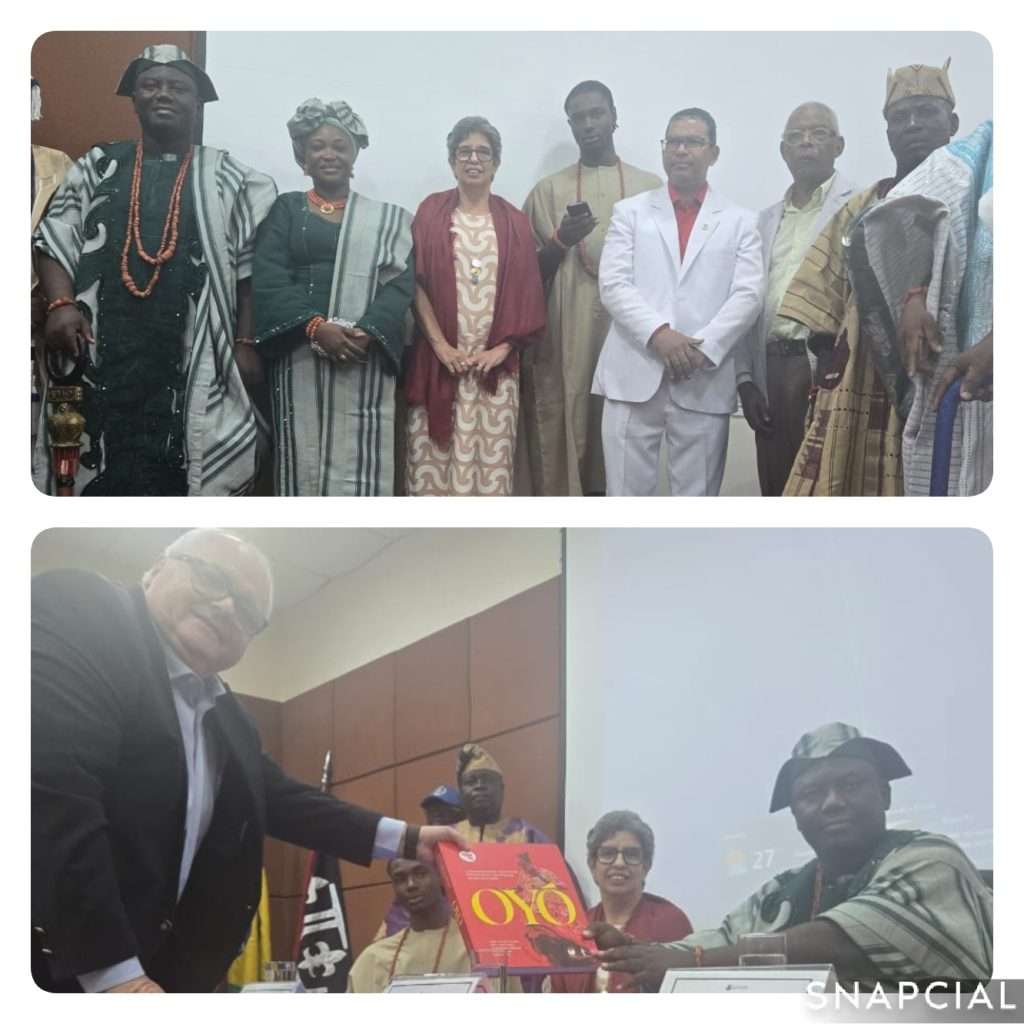
Speaking at Bahia State University, UNEB, before scholars, cultural leaders, government representatives, and Yoruba in the diaspora, the Titan of Yorubaland said Yoruba civilisation is not folklore, but a working blueprint for governance, science, and social welfare.
“I am here as conscience, symbol, and spirit of the Yoruba,” Oba Owoade told a hall that erupted in applause repeatedly. “The personification of its glorious traditions of excellent public administration, social welfarism, and egalitarian social and kinship system.”*
In a statement signed by his Director of Media and Publicity, Bode Durojaiye, the Alaafin said Yoruba culture and civilisation have endured as the fulcrum of political, economic, religious and intellectual development till today.
“A careful reading of the Yoruba intellectual traditions would reveal the extent and ramifications of the Yoruba system of knowledge,” he said.
“If properly studied, it would reveal how knowledge was tested, applied and used to solve real human problems.”
He urged world leaders to urgently re-integrate Yorubas across the globe back to their ancestral roots “to save their souls from continued trauma.”*
He also commended UNESCO for plans to proclaim Oyo as an international heritage site of exceptional value.
Tracing history, the monarch noted that the Old Oyo Empire ran one of West Africa’s most sophisticated governments as far back as the 16th Century.
“The Empire developed the cabinet system of government, from the Prime Minister to the Alaafin, with roles, separation of powers, and checks and balances clearly spelt out”*
He said “If the Empire was not anchored on equity, fairness and justice, it would not have lasted over 600 uninterrupted years.”
Oba Owoade disclosed that the Oyos were not called Yorubas originally explaining that in the 19th century, to forge a common ground, the Oyo dialect was embraced by all. So, Yorubas are Oyo’s by origin,” he said
He linked Yoruba success to productive economies that gave artists freedom.
“The Yoruba possessed famous traditions of art because they had vibrant commercial systems which provided access to metals, woods and clay. But how preserved are our cultures of excellence, dedication, determination and ingenuity? Are they not fading away?
The Alaafin said Yoruba impact is visible far beyond Nigeria. “In modern Brazil, Cuba and the Americas, their religion and culture have remained pervasive. This remarkable cultural triumph makes the Yoruba experience one of the most fascinating subjects of historical study in the world.”*
“People carry in their veins the rich, strong, virile Yoruba blood that has refused to be polluted,”* he added, charging the diaspora to be “devoted and devotional in preserving our sacred intellectual property despite orchestrated condemnation of its relevance.”
Calling education utilitarian, Oba Owoade said: “Africa is today at the crossroads of history, to lead a liberating revolution in knowledge production, dissemination and utilization. The deep will begin to call to the deep in an all-inclusive enterprise.”*
He closed with a call for deeper study of Yoruba ontology: “It is my wish that we explore the height and depth of Yoruba intellectual traditions, and establish enduring connections between our worldview and the role the South West must play in contemporary global dictates.”
The event ended with the presentation of a trilingual book, Oyo: A City of Yoruba Cultural Heritage” written in Yoruba, English and Portuguese.