By Comrade Tgst. Umeh Ikechukwu


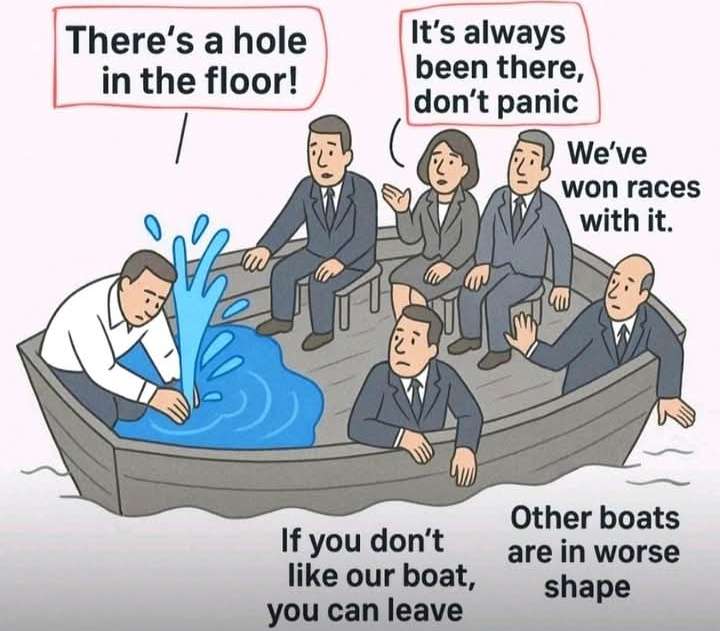
In the journey toward national renewal and constitutional democracy that truly works for all, nothing illustrates our predicament more vividly than a simple but powerful cartoon: a sinking boat, a gaping hole at one end, and leaders on the other end—calm, blind, or indifferent—urging the crew to keep paddling harder, faster, stronger. The image speaks not only to failing corporate or organizational leadership—it is a mirror reflecting the state of our nation.
This cartoon is more than satire. It is a damning metaphor of what Nigeria has become—a system where dysfunction has been normalized, where alarm bells are ignored, and where those who dare to raise critical issues are silenced, ridiculed, or sidelined. It’s a portrait of the Nigerian condition: a centralized, overburdened federal structure riddled with inefficiency, corruption, injustice, and poor leadership—yet somehow expecting performance, unity, and progress from its weary citizens.
We are a country that has grown comfortable with cracks in the hull. Instead of confronting the root causes of our crises—like the distorted federalism, unequal resource control, marginalization, youth unemployment, insecurity, or systemic injustice—we sweep them under the carpet with slogans and empty reforms. We tell ourselves, “It’s always been this way,” or “Let’s manage it,” or worse, “Others have it worse.” These are the justifications of failing empires.
Real leadership, whether in public office or community advocacy, is not about pretending all is well while the system collapses. Leadership is not a performance—it is responsibility. It is about listening deeply to the cries of the oppressed, recognizing the warning signs of structural decay, and having the moral courage to act—not tomorrow, but now.
In Nigeria today, we see a dangerous pattern:
We minimize the signs of national burnout—rising ethnic tensions, youth disillusionment, economic collapse—while pushing citizens to “do more with less.”
We ignore the hemorrhaging talent pool—as our brightest minds flee in droves through the Japa wave—while offering token gestures instead of structural reforms.
We romanticize our suffering—as if hardship were a badge of honor—while excusing inefficiency, corruption, and incompetence.
This is not how nations rise. This is how they fall.
To every decision-maker, political leader, and policymaker reading this: Nigeria is not unbreakable. No nation survives long when its leaders keep bailing water with a cup while ignoring the crack in the hull. No federation remains strong when injustice is institutionalized, and cries for restructuring are dismissed as noise.
Restructuring is not a threat to national unity—it is the foundation of it. It is the recognition that no one-size-fits-all system can serve a nation as vast, diverse, and historically wounded as Nigeria. It is about decentralizing power, empowering regions, giving local governments autonomy, and designing a new constitutional order that reflects equity, justice, and true federalism.
We must move beyond survival politics. Nigeria must not continue as a place where only the elite thrive while the masses sink. We must envision and build a resilient republic—where leadership listens, systems are sustainable, and every citizen has a stake and a voice.
The warning signs are clear. The alarms are ringing. The cracks are visible. The hole is widening.
The question is: will we, as a people and as leaders, pretend not to see it—until the boat finally sinks? Or will we rise, restructure, and rescue this nation before it is too late?
This is not just food for thought. It is a clarion call. A summons to duty. A moment to choose between historical failure and a future redeemed by bold, transformative action.
Let us act. Let us fix the boat.
Comrade Tgst. Umeh Ikechukwu is the Southeast Regional Director, Information, Media, and Strategies – The Rebirth Group (NNEF)
Public Relations Officer – National Consultative Front (NCFront), Enugu State
Spokesperson – The Big Tent, Enugu State Chapter
Activist | Social Crusader | Nationalist | Advocate for a New Nigeria